Discover the Spermidine-Fertility Parallel: why natural spermidine levels drop with age in perfect sync with declining egg and sperm quality. Learn the 3–6 month optimal preconception window for autophagy support with Liposomal Spermidine — fertility optimized at the cellular level.
The Spermidine Connection to Fertility Decline
Fertility optimized at the cellular level — this is the core shift Progeny Brands champions. No longer is it enough to start a generic prenatal vitamin once pregnant. Today’s research-driven couples, especially women 30–45 and men 30–45, understand that true preconception optimization begins months earlier by supporting the cellular processes that determine egg and sperm quality.
One of the most compelling pieces of evidence is the striking visual correlation between natural spermidine decline and reproductive aging. Our infographic below illustrates this “Spermidine-Fertility Parallel” with crystal clarity: as endogenous spermidine levels fall, egg quality and sperm quality decline in near-perfect alignment. By middle age, spermidine levels have dropped approximately 60%, while aneuploidy risk in embryos climbs dramatically after age 42.
This parallel is not coincidental. Spermidine is a master regulator of autophagy — the cell’s recycling system — and specifically mitophagy, the targeted removal of damaged mitochondria. When these processes slow, oxidative stress rises, damaged cellular components accumulate, and the energy factories (mitochondria) in eggs and sperm falter. The result? Lower fertilization rates, poorer embryo quality, and increased challenges for both natural conception and IVF.
The good news? Restoring spermidine levels through targeted supplementation can reactivate these protective mechanisms, offering a proactive, low-cost layer of support — especially valuable when an IVF cycle can cost tens of thousands while quality cellular optimization represents a fraction of that investment.
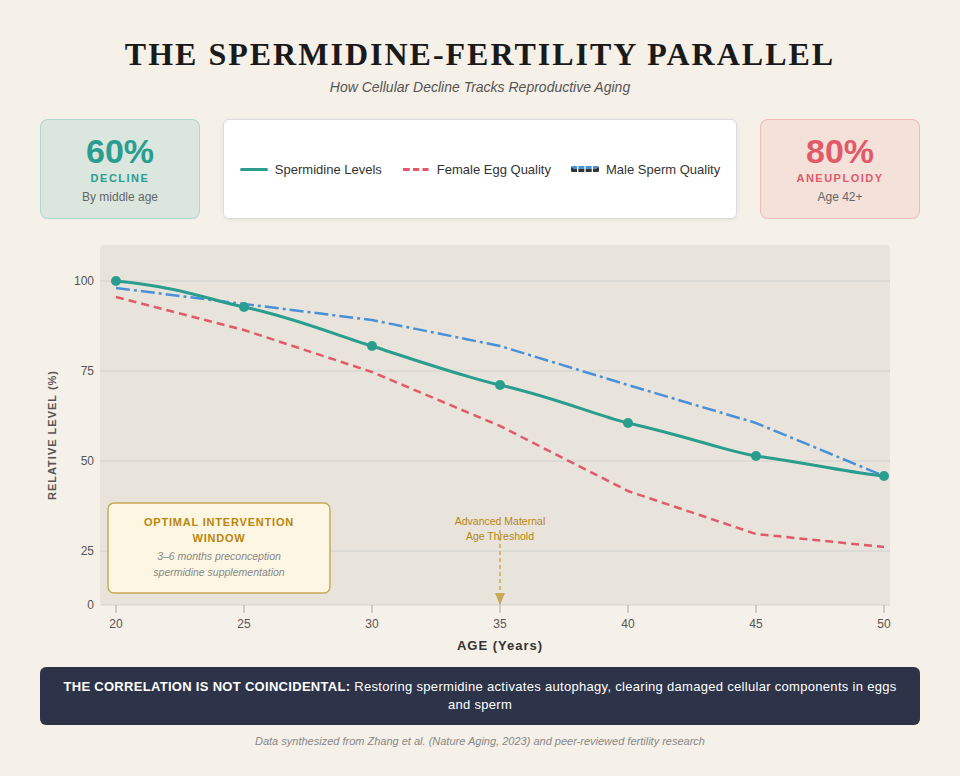
An infographic showing how Spermidine levels track alongside Female Egg and Male Sperm decline as humans age. This direct correlation between Fertility and Spermidine levels is based on peer-reviewed studies and cutting-edge scientific data. Feel free to link directly (required) to this infographic for free use.
Understanding the Spermidine-Fertility Parallel
The graph reveals three key trends over reproductive age (20–50 years):
- Green line (Spermidine Levels): Natural cellular spermidine declines steadily, reaching roughly a 60% drop by middle age.
- Dashed red line (Female Egg Quality): Begins a noticeable descent in the early 30s and accelerates after the advanced maternal age threshold of 35.
- Dotted blue line (Male Sperm Quality): Shows a parallel but slightly delayed decline starting in the mid-30s.
By age 42+, aneuploidy (chromosomal abnormalities) risk surges to approximately 80%. These patterns align closely with the biology of ovarian follicle development in women and the 74-day spermatogenesis cycle in men.
At the cellular level, declining spermidine impairs autophagy and mitophagy. Mitochondria in aging oocytes and sperm produce more reactive oxygen species (ROS), leading to oxidative stress — the hidden saboteur of conception. This stress damages DNA, proteins, and lipids essential for healthy fertilization and early embryonic development.
The Science Behind the Parallel
Landmark research published in Nature Aging (2023) by Zhang et al. provides strong mechanistic insight. In aged mice (equivalent to advanced maternal age in humans), spermidine levels in ovaries were significantly reduced. Supplementation restored oocyte quality by enhancing mitophagy — the selective clearance of damaged mitochondria — and improving mitochondrial function.
Treated aged females showed:
- Better follicle development
- Improved oocyte maturation
- Enhanced early embryonic development
- Nearly doubled fertility outcomes in some models
Importantly, the mechanism was conserved in porcine (pig) oocytes under oxidative stress, suggesting translational relevance for human fertility. Additional studies confirm spermidine’s ability to reduce ROS, inhibit apoptosis (programmed cell death), stabilize the cytoskeleton and spindle in oocytes, and protect against postovulatory aging defects.
For men, the picture is equally relevant. Male factor contributes to up to 50% of infertility cases overall. Spermidine supports sperm motility, morphology, and DNA integrity by reducing oxidative stress and supporting mitochondrial health in sperm cells. As spermatogenesis takes approximately 74 days, consistent support during this window can meaningfully influence sperm quality.
These findings align with broader evidence that spermidine levels naturally decline with age across tissues, and restoring them activates cellular cleanup pathways linked to healthier reproductive outcomes.
Why the 3–6 Month Optimal Intervention Window Matters
Biology dictates timing. Ovarian follicles develop over months, and sperm require a full 74-day cycle to mature. Starting preconception optimization 3–6 months ahead allows autophagy and mitophagy to clear accumulated damage before critical stages of egg and sperm development.
This window is your best opportunity to intervene at the cellular level — before the steepest declines in quality become evident. For couples pursuing IVF, this preparation can serve as valuable “cellular insurance,” complementing clinical treatments. Studies show that up to 70% of fertility patients already use supplements, though many do not disclose them to their doctors — highlighting the need for transparent, evidence-based options that integrate well with medical care.
Who Benefits Most from the Autophagy Optimized Conception Protocol?
This science speaks directly to Progeny’s core audience:
- Women 35–45 facing advanced maternal age, who are research-driven and motivated to protect egg quality.
- Women 30–39 proactively planning families, often after delayed childbearing.
- Men 30–45, where male-factor issues are common yet frequently under-addressed.
- Couples in Trying-to-Conceive (TTC) communities or preparing for IVF who want clean, natural, discreet support that complements — rather than replaces — medical protocols.
Our Autophagy Optimized Conception Protocol (AOCP) focuses on spermidine delivered via liposomal spermidine — our advanced liposomal formulation for superior bioavailability and true cellular uptake.
How to Apply This Science to Your Journey
- Assess your timeline — Aim to begin 3–6 months before actively trying or starting an IVF cycle.
- Support autophagy daily — Consistent Liposomal Spermidine helps maintain spermidine levels for ongoing mitophagy and oxidative stress defense.
- Combine smartly — Pair with a nutrient-dense diet, stress management, and — when appropriate — fasting-mimicking approaches that further boost autophagy.
- Track and communicate — Discuss any supplements with your reproductive endocrinologist for full integration with your care plan.
Our 90-day bundles are designed precisely around the biological cycles of egg and sperm development.
FAQ
What is the Spermidine-Fertility Parallel? It is the observed correlation between declining natural spermidine levels and parallel drops in egg and sperm quality with age, driven by reduced autophagy and mitophagy.
Can spermidine improve egg quality after 35? Emerging research, including the 2023 Nature Aging study, shows spermidine supplementation enhances mitophagy, reduces oxidative stress, and improves oocyte quality and maturation in aged models — offering promising support for women in advanced reproductive years.
Is spermidine beneficial for male fertility? Yes. It helps protect sperm from oxidative stress, supporting motility, morphology, and DNA integrity — relevant given male factors contribute to up to 50% of infertility cases.
How does Liposomal Spermidine differ from standard forms? Liposomal encapsulation enhances bioavailability, helping deliver spermidine more effectively to cells where it can activate autophagy and mitophagy.
Is it safe to take while preparing for IVF? Many patients use supplements alongside treatment. Always consult your fertility doctor before starting, as individual needs vary.
How long should I take it preconception? The optimal window is 3–6 months to align with follicle development and spermatogenesis cycles.
Conclusion
The Spermidine-Fertility Parallel makes one thing clear: declining cellular health doesn’t have to define your conception journey. By understanding and addressing the drop in natural spermidine, you can proactively support autophagy, protect mitochondrial function, and fight oxidative stress at the source.
This is fertility optimized at the cellular level — targeted, science-backed, and designed to complement your broader efforts whether trying naturally or through IVF.
Ready to take control of your preconception cellular health? Explore our Liposomal Spermidine bundles formulated for the 90-day cycles that matter most.
Speak with your doctor before beginning any new supplement, particularly if you are undergoing fertility treatment.
Data synthesized from Zhang et al. (Nature Aging, 2023) and supporting peer-reviewed fertility research on spermidine, autophagy, mitophagy, and reproductive aging.
Pingback: The Science of Spermidine and Fertility - progenybrands.com
Pingback: Liposomal Spermidine vs. Regular Spermidine: The Bioavailability Breakthrough for Preconception Optimization, Egg Quality, and Sperm Health - progenybrands.com